Cliff Booth’s Medal of Valor
Once Upon a Time in HollywoodCliff Booth’s Medal of Valor connects his wartime survival to the hard-edged authority he asserts afterward. Carried among the money and two medals he had when discharged, it later becomes more than a decoration: Cliff makes its weight and public display part of a confrontation with two Italian gangsters.
Wartime Context
After World War II, Cliff left military service with money and two Medals of Valor, facing the question of what to do with a future he had once expected not to have. During the war, he had thought death likely in Sicily; after transfer to the Philippines to fight alongside Filipino guerrillas against the occupying Japanese military, he was convinced he would never return home. Captured and confined in a makeshift jungle POW camp, he considered himself already as good as dead. He then led Filipino prisoners in overthrowing their captors, executing the camp personnel, escaping into the jungle, and rejoining their resistance fighters.
The book does not say that the Medal of Valor was awarded for the prison-camp escape. In the later confrontation, Cliff connects the medal instead to a day of killing in Sicily. The distinction matters: his account of the medal’s significance rests on his own specific claim about that day, not on a stated citation or an explicit link to the escape.
The Medal on the Table
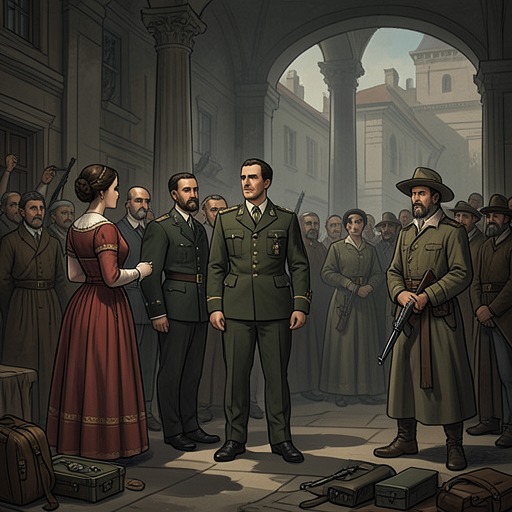
Years later, facing Pat and Mike, Cliff brings the medal out of his front jacket pocket and drops it onto the wooden table between them. It lands with a loud bang. The gesture turns a concealed possession into the center of the encounter: instead of merely asserting his wartime record, Cliff makes the medal visible and audible to the two men.
Pointing to it, he says that on the day he received it he killed at least seven Italians, perhaps as many as nine, and adds that he killed Italians every day while he was in Sicily, where he served for a long time. He presents the medal as proof of the identity his words claim for him: a war hero whose violence is not just bluster. The book supplies Cliff’s account but does not independently establish the medal’s award circumstances or verify his figures.
Display and Threat
Cliff uses the medal to lead into a second object: he takes a snub-nose .38 from his other jacket pocket and places it beside the medal. Pat and Mike jump when they see the pistol. Cliff then invokes his status as a war hero to claim a license to carry it and threatens that he could shoot both men dead in the pizza parlor, in front of its owner, waiters, customers, and Charlie Chaplin.
The medal’s role is therefore both evidentiary and theatrical. Its sharp impact on the table gives material form to Cliff’s account of past violence; placed beside the gun, it helps turn that past into an immediate threat. The encounter makes the decoration an instrument of intimidation, while leaving the force of the gesture rooted in the gap between a remembered war and the danger Cliff says he can produce in the present.